Thursday, September 19, 2013

Barry Beach’s full clemency application

http://assets.nydailynews.com/polopoly_fs/1.1345188!/img/httpImage/image.jpg_gen/derivatives/landscape_635/barry-beach.jpg

In response to reader interest I’ve scanned and posted Barry Beach’s entire 413-page clemency application.

As most Lowdown readers know, Beach is once again appealing to the Montana Board of Pardons and Parole, this time asking them to commute his 100-year, no-parole sentence.

More than 200 people wrote letters to the board on Beach’s behalf, including Sen. Jon Tester, former Sen. Conrad Burns, and Billings Mayor Tom Hanel.

Below is a DocumentCloud including the entire clemency application. To view and download the file (57 mb) in a separate window click here.

The letters begin on page 73.

Thursday, September 12, 2013

Allegations against former Montana Highway Patrol chief uglier than previously revealed

http://cmsimg.greatfallstribune.com/apps/pbcsi.dll/bilde?Site=G1&Date=20130911&Category=NEWS01&ArtNo=309110022&Ref=AR&MaxW=300&Border=0&Hickethier-accused-sexual-harassment

According to an email Montana Highway Patrol Trooper Glenn Quinnell sent to a superior officer in Aug. 2011, former MHP chief Col. Kenton Hickethier’s comments and behavior at a law enforcement conference in Arizona were pretty obscene.

I’m publishing the entire civil rights complaint case file below in DocumentCloud format so you can read it for yourself. I highlighted some of the most offensive content. WARNING: The documents contain obscene language that may offend some readers.

As the Tribune reported on Sept. 11, Quinnell accused Hickethier of sexual harassment, ordering state troopers to make illegal arrests and making racist comments, and then retaliating against him after he brought Hickethier’s actions to the attention of his superiors.

Hickethier retired from MHP on Aug. 30 after his comments were revealed to Montana Attorney General Tim Fox’s office. Fox’s spokesman said Fox did not ask Hickethier to resign, but Hickethier offered up his retirement citing his inability to lead by example after making such “inappropriate” comments.

Fox appointed Hickethier in January 2013. Fox’s spokesman said Hickethier’s application, references and reputation gave the hiring team no indication that they ought to check out his personnel file.

According to the state’s response to Quinnell’s allegations, the now-retired MHP chief doesn’t deny he said and did the things Quinnell alleges, including making a seriously offensive comment about Quinnell’s wife, making a racist statement about Quinnell havening dinner with black troopers from another state, and a mean-spirited “joke” about an overweight speaker at the conference.

image

The state Department of Justice, in a 19-page response, admits to the majority of Quinnell’s allegations about Hickethier’s behavior, but denies Hickethier retaliated against Quinnell.

The state denies that Quinnell was “passed over” for promotion. The state argues Quinnell was not promoted because he was not among the most qualified and highest-scoring applicants for the various positions.

image 


(Click this box on the DocumentCloud viewers below to view the documents in a separate window.)

Here is Quinnell’s amended human rights complaint:

Here’s the state’s response to Quinnell’s complaint, which includes the email Quinnell sent to his superiors in Aug. 2011. WARNING: This is the document that contains the offensive language. Viewer discretion is advised.

Here’s Quinnell’s rebuttal to the state’s response:

Wednesday, September 11, 2013

Video of Westboro Baptist Church’s unsuccessful Montana demonstration

(Editor’s note: Some readers have reported difficulty viewing the Tribune videos embedded in this blog. As a courtesy I uploaded a YouTube version as well as the complete story from Monday’s demonstration. Please visit GFTrib.com for more great news videos from around Montana. )

BOZEMAN - A handful of sign-waving acolytes of the Kansas-based Westboro Baptist Church did not find a receptive audience on the campus of Montana State University in Bozeman on Monday afternoon.

Hundreds of people from across Montana’s vast geographical, political and social spectrum descended upon the controversial demonstrators to counter the group’s message that God is punishing the United States for tolerating lesbian, gay, bisexual and transgender residents.

Westboro Baptist Church is famous for picketing the funerals of fallen soldiers with messages such as “Thank God for IEDs.” More recently they made headlines by claiming the shooting massacre at Sandy Hook Elementary School was God’s work.

The church, which has been widely condemned by religious leaders, veterans groups and human rights groups for more than a decade, announced earlier this year that it planned to picket MSU and Bozeman High School.

Approximately five Westboro demonstrators stood on a corner across from Veterans Memorial Park holding signs. However, the demonstrators and their signs were barely visible through the throngs of counter-demonstrators who quickly surrounded and obstructed the view of the Westboro picketers.

Robbie Regennitter of Great Falls was with a group called Patriot Guard Riders. The Patriot Guard Riders travel to Westboro demonstrations around the United States to show support for America and to denounce hate.

“I don’t think anybody needs to be preaching hate,” Reggennitter said. “There’s enough hate in the world already.”

A group of motorcyclists from the Patriot Guard Riders and a pair of men in a muscle car did laps in front of the Westboro picketers, revving their loud engines and drawing huge cheers from the raucous crowd.

Many counter-demonstrators and those gathered at a nearby anti-hate rally just a few hundred yards away on the campus grounds wore T-shirts and held signs denouncing Westboro’s message.

MSU Junior Matt Morris of Greeley, Colo., donned a homemade T-shirt that read “I’m a Christian and God Loves this Campus.”

Morris said Westboro’s teachings run counter to true Christian principles.

“I came out here today to support a positive image of Christians,” Morris said.

The anti-hate rally drew even more people than the anti-Westboro picketers as hundreds gathered to hear speakers talk about equality, acceptance and dignity for the LGBT community.

Event organizer Jamee Greer of the Montana Human Rights Network said Westboro’s unwanted presence created an opportunity to have a conversation about the broader movement for equality for LGBT Montanans.

Greer said Montanans sometimes lose sight of the fact that unlike other parts of the country where the LGBT community enjoys many of the same rights as heterosexual residents, Montana only recently struck language from its code books making it illegal to be gay.

Greer said Westboro’s appearance in the state gives Montanans a good opportunity to examine issues like dignity, safety, security and fairness for all.

“I think groups like Westboro Baptist Church coming to town give us an opportunity to talk about where discrimination exists and how we can work together to end it,” Greer said.

Dr. Jay Smith, pastor of the First Baptist Church in Bozeman, addressed rally-goers. Smith said the Westboro Baptist Church does not represent the true teachings of the Baptist Church.

“You need to know that by some definition I, too, am a religious nut job, just of a different sort,” Smith said. “As a follower of Christ, I believe that God loves everyone: red, yellow, black, brown, white, gay, lesbian, transgender, straight, drunks, drug abusers, gossips, musicians, religious people, atheists, athletes, nerds, educated intellectualists and homespun country folks. Everyone.”

Rabbi Ed Stafman, of the Congregation Beth Shalom of Bozeman, is the acting chairman of the Gallatin Valley Interfaith Coalition.

Stafman said the rally was aimed at showing the world that Bozeman does not tolerate hate toward any group or people.

“This is a gathering to make the affirmative statement that Bozeman is a place where we tolerate diversity, and we seek equality,” Stafman said. “It doesn’t matter who the victim du jour may be.”

Tuesday, September 3, 2013

Highway patrol chief disciplined in 2008 and 2011 for inappropriate comments

The recently retired chief of the Montana Highway Patrol was disciplined in 2008 and 2011 for inappropriate comments he made to subordinates under his command.

Col. Kenton Hickethier announced Friday that he is retiring effective Sept. 30 after just seven months on the job.

According to memos contained in Hickethier’s personnel file, the former captain was twice officially reprimanded for violating Montana Highway Patrol policy, which requires officers to “treat supervisors, subordinates, and associates with respect and courtesy.”

The incidents came to light in the wake of a discrimination complaint filed against Hickethier earlier this summer.

The first incident occurred in March 7, 2008. According to the disciplinary memo in Hickethier’s file, on that date Hickethier told a female trooper that other troopers were upset with her and, “If she were a man they would take her behind the woodshed.”

A second incident occurred the week of Aug. 16, 2011, at a law enforcement meeting in Phoenix.

According to his personnel file, at that event Hickethier made inappropriate comments “in regard to the age of (an unidentified trooper’s) spouse, a joke in regard to a female instructor’s weight, and a comment about (an unidentified trooper) having dinner with black troopers from North Carolina.”

According to the memos, Hickethier “took responsibility” for his comments.

John Barnes, a spokesman for Attorney General Tim Fox, said the disciplinary records came to light after a Montana Highway Patrol employee filed a discrimination complaint against Hickethier with the Montana Department of Labor and Industry’s Human Rights Bureau. Fox’s office was notified of the complaint July 10.

“In preparing our response to that complaint we became aware of the fact that Col. Hickethier, prior to being named colonel, had been disciplined for two instances of making inappropriate comments to troopers,” Barnes said.

Barnes said the decision to retire was entirely Hickethier’s.

“The Attorney General’s Office did not ask him to retire,” Barnes said.

Barnes said Hickethier notified Fox’s office Wednesday of his decision. 

“I regret that I have made inappropriate remarks to subordinates that have compromised my ability to effectively lead Montana’s Highway Patrol by example. Therefore, I have chosen to retire from the patrol,” Hickethier said in a written statement released by Fox’s office Friday. “I am sorry for these mistakes and any harm they may have brought to Montana’s finest law enforcement agency, which has been the center of my life for the last 28 years.”

News of Hickethier’s retirement was held until after Friday afternoon’s graduation ceremony for new Montana Highway Patrol troopers.

“We felt it would not be appropriate for that announcement to interfere with that ceremony,” Barnes said.

Barnes said Fox’s transition team found no red flags while reviewing Hickethier’s application for chief of the Montana Highway Patrol that would have triggered a review of his personnel records.

“During the transition process every applicant for every appointed position was asked if there was anything in their background that was problematic or inappropriate and they were asked for permission, if necessary, to review their personnel record,” Barnes said. “(Hickethier) interviewed very well, he had a very strong resume, and he had absolutely glowing reference checks. Based on all of that there was no reason to believe there was a problem, and so those past incidents referenced in 2008 and 2011 were not known.”

Hickethier is no longer serving for the Montana Highway Patrol and is using up leave time until his official retirement date. His home telephone number is not listed, so he could not be reached for comment.

Monday, August 5, 2013

AP reporters receive threats after Montana attorney general denies records request

Freedom of the press is fundamental to a functioning Democracy.

One of the pillars of a free press is the public’s Right to Know.

Both were threatened last week after Attorney General Tim Fox made a public display of denying an open records request by Associated Press reporter Matt Gouras.

In the days following Fox’s announcement that he would not fulfill the AP’s request for information on concealed carry permit holders in Montana, Gouras and other Montana AP reporters began receiving threats online.

Here are just of the few of the most sinister threats:

image

image

image

In another online forum anonymous commenters posted Gouras’ home address and even a Google Street View photo of Gouras’ house.

The Associated Press declined to comment on the threats.

Fox’s spokesman, John Barnes, said in a statement that the Attorney General’s Office was not aware of any threats made against AP reporters or their families.

“If employees of the Associated Press – or any citizens – have received threats, they should contact their city police department or county sheriff office,” Barnes said via email. “The Montana Department of Justice can assist in investigations when requested by local authorities.”

This all stemmed from Gouras’ March 18  request for public information on current concealed carry permit holders, including, but not limited to, last name, first name, middle name, street address, city,  employer, age or date of birth, driver’s license number, date of application.

Earlier this year the Montana Legislature passed a law, which Gov. Steve Bullock signed, barring the state from reveal information on concealed weapons permit holders to the press or the public. The law is set to take effect on Oct. 1. The AP made the request before the law had even passed before it was signed into law.

In a July 17 memo Fox denied Gouras’ request for the information citing the Montana Constitution’s privacy provisions. Rather than send Gouras notice denying the request and move on as is customary, Fox chose to grandstand and go on a media blitz, talking about his decision on NRANews.com’s Cam & Co. radio show, as well as making appearances on local television and radio news stations across the state.

(Update 8/5/2013 5:10 p.m.) According to Fox spokesman John Barnes, the Attorney General’s Office sent the July 17 memo only to Associated Press reporters Matt Gouras and Matt Volz as well as to county attorneys and Montana sheriffs. Barnes said he doesn’t know how other media outlets found out about the memo but that there was no effort on the attorney general’s behalf to publicize the decision. Barnes said after the news got out other media outlets requested Gouras’ original request.

Fox called the AP’s request “pretty unprecedented,” a “bad idea” and said:

“Quite frankly I can’t think of a reason where it would be legitimate or reasonable to publish this amount of information or to release it to any individual.”

To the average person not regularly involved in news gathering and public information requests, Gouras’ request might seem intrusive. In actuality, the press requests this kind of information all the time. Good reporters regularly request all kinds of documents, information and data from Government agencies. We usually ask for as much detail as we can get and then work back from there. Sometimes privacy laws dictate what information we can and can’t have, in which case we work out those details with the agency. We make a habit of doing this on the public’s behalf. It’s how we find patterns in mounds of data. It’s how we hold government accountable.

The Associated Press has a long history of this kind of reporting. It was not too long ago Gouras uncovered the fact that hundreds of people barred from having guns because they are felons on parole or probation were still able to get hunting licenses in Montana with no questions asked.

Gouras didn’t publish the names of everyone who had a hunting license. He didn’t reveal a list of all the felons and parolees in the state. He cross referenced two sets of data and developed a good story from what he found.

The reaction from the pro-gun  world was swift and harsh as the headlines on conservative blogs and traditional media outlets alike questioned not Fox’s denial of a public records request, but the AP’s motivations in making it in the first place.

The message from the online pro-gun forums was clear: the public doesn’t have a right to know who holds a concealed carry permit. Some extremists made that point even sharper by warning other journalists that making such an request could be a mortal sin.

Such threats and intimidation tactics toward journalists should not be tolerated anywhere, particularly in a country whose founding document enshrined freedom of the press in the First Amendment to the U.S. Constitution.

The biggest critique against the AP’s request for the information seems to be the fact that they wouldn’t comment on what they intended to do with it.

The beautiful thing about the public’s Right to Know is that it’s our Right to Know. We don’t have to tell the government why we want the information or what we plan to do with it. It’s the government’s job to turn it over and it’s the journalist’s job to deal with the data and information in a responsible manner.

People will point to the incident last December when a New York paper published the names and addresses of local gun owners.

You could argue that was a poor decision on their part. I think most journalists would argue right alongside you.

But one newspaper’s poor decision does not mean every journalist who requests information will disseminate it in such an irresponsible manner.

In Montana there is a history of great news reporting stemming from similar requests.

In 2008 then-Lee Newspapers state bureau reporter Jennifer McKee wrote a story on how nine sitting lawmakers had permits to carry concealed weapons.

In 2000 the Missoulian published a story on how the number of concealed weapons permits was climbing.

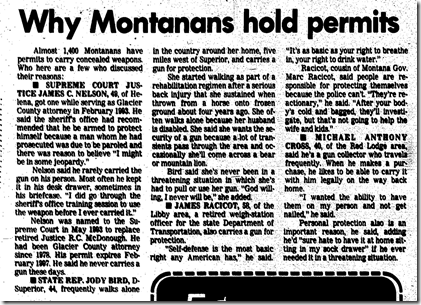
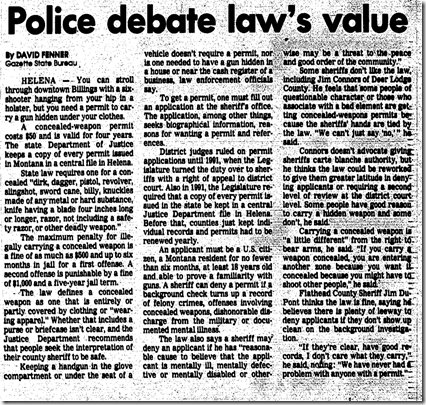
In 1994 Lee Newspapers capitol bureau reporter  David Fenner did a series of stories on concealed weapons in the state. The top story in the January 23, 1994 edition of the Billings Gazette featured a four-part report on gun-bearing Montanans, including an analysis of the concealed carry permit database.

One of Fenner’s stories explored the rise in permit holders.

image

Another featured interviews with concealed weapons permit holders, including Montana Supreme Court Justice James Nelson, former State Rep. Jody Bird, D-Superior and former Gov. Marc Racicot’s cousin. Presumably
image

A third story explored how a small community near the Hi-Line saw a spike in concealed weapons permit applications after a security manager at a local mine warned of the dangers of “environmental extremists.”

image

A fourth article debated the concealed weapons law’s effectiveness in deterring violent crime:
image

Update (8/5/2013 3:50 p.m.): Just last Thursday in the Outdoors section, the Tribune did a story on women carrying concealed weapons that would not have been possible without substantiating the information with the government. It gave insight into an important story in a responsible way.

So yes, there are “legitimate” and “reasonable” reasons for requesting this kind of information.

Associated Press Bureau Chief Jim Clarke gave me this statement about Gouras’ request and the AP’s intentions for the data Fox refused to turn over:

“After the Montana Legislature voted to remove from the public record information on whom the government had granted permits to carry concealed weapons, effective Oct. 1, The Associated Press requested a database of these files that had long been accessible to the public.

AP acted under freedom of information law, which we do routinely in seeking records at the federal, state and local level as part of our newsgathering process and our long-standing mission to assure transparency and accountability in government.  Montana’s Constitution contains such a Right to Know clause, which says: “No person shall be deprived of the right to examine documents.”

We have never had any interest in publishing the Montana database in its entirety.”

It is unclear at this point if the Associated Press or other news outlets plan to sue in court for access to the records.

Friday, August 2, 2013

Tribune editorial: Judiciary should release Cebull report

Republished editorial from the Aug. 1, 2013 Great Falls Tribune.

Richard Cebull of Billings has retired as a federal judge, not taking senior status as some judges do, but retiring outright.

So a 17-month-old flap over Cebull forwarding a crude email to acquaintances about President Barack Obama’s mother is all over with, right?

Not exactly.

Before Cebull hung up his judicial robe, the 9th Judicial District Court of Appeals, which oversees federal judges in the West, including Montana, launched a misconduct investigation into activities of the Montana judge through its arm called the Judicial Council.

What the investigation found is not clear because the 9th Circuit so far has declined to release the report or a summary of it.

At one point, the Judicial Council of the 9th Circuit declared the issue moot because Cebull retired, an approach that would have simply swept the matter under the proverbial rug.

Then the council composed a final order in the matter July 2, explaining the order would be released to the public and the media Sept. 4, if no petition for review is filed. If a petition for review is filed, the release could be delayed or not happen at all.

The Tribune, which is owned by the Gannett Co., sought release of more information about the Cebull probe.

“We believe the circumstances in this case weigh heavily in favor of public disclosure,” wrote Barbara Wall, Gannett’s vice president and senior associate general counsel, to Judge Alex Kozinski, chief judge of the 9th Circuit. “Judge Cebull waived his confidentiality when he publicly requested that the Judicial Council review his conduct, and public interest certainly is high in this controversial case. We therefore believe the public has a right to know the details and outcome of the investigation into Judge Cebull’s conduct, and I hope you will agree.”

The court’s response was the news that, barring a petition for review, the July 2 final order would be released Sept. 4.

Cebull’s original joke email he forwarded drew widespread condemnation and worldwide attention. Delays and confusion involving the council’s investigation indicate there may have been more to the flap than simply one email Cebull forwarded.

Initially, the judge told the Tribune he did not like Obama but conceded the email was offensive. He quickly sent a letter of apology to the president, and in May, he retired from the bench.

This country has an elaborate system of checks and balances involving the three main branches of government — Congress serves as the legislative branch, the president runs the executive branch and the third is the judicial branch.

Voters can cast votes against the president or members of Congress if they are unhappy with their performance while in office. Federal judges are appointed for life, so they are not required to face periodic votes to stay in office.

While we have no problem with insulating federal judges from periodic public approval, we do think there is a special obligation on the part of the judiciary both to act in an ethical manner and to police the judicial branch, making sure that misconduct is not tolerated.

We believe releasing the report on Cebull would provide a reassurance in the public mind that the federal judiciary is acting appropriately and providing some transparency in the self-policing of colleagues.

We encourage the 9th Circuit to release its report to the public as a matter of reassurance and transparency.

Judges do not have a easy job to perform, of course, but it’s important that the judiciary demonstrate some openness in such matters.

This is also a useful time to repeat advice we have given in the past and will continue to offer — don’t put anything in an email that you would not want to be splashed across the front page of a newspaper. Don’t expect an email to be secret and confidential.

Plenty of people would benefit by heeding this advice.

In the meantime, we believe the 9th Circuit can mend this bit of embarrassment in its ranks by showing openness about its investigation before finally putting this matter to rest.