Thursday, March 31, 2011

Jim Messina, Obama’s Fixer

Messina

Ari Berman, of The Nation, just published a scathing 3,700-word analysis on the role Montana’s own Jim Messina plays in driving President Barack Obama’s political agenda and reelection campaign.

Messina, of course, was Sen. Max Baucus’ chief of staff until he left to help run Obama’s successful 2008 presidential campaign.

Berman paints a picture of a tough political enforcer intolerant of dissent and fiercely loyal to his boss. It is not a flattering picture of “the most powerful person in Washington that you haven’t heard of.”

Messina, who has served as Obama’s deputy chief of staff under Rahm Emmanuel, is now running Obama’s reelection campaign. The article portrays Messina as the man responsible for turning the Obama ‘08 campaign of  “hope and change” into the Obama administration of “legislative compromises and political timidity.”

“Under Messina, Obama ‘12 could more closely resemble the electoral strategy of Baucus or Bill and Hillary Clinton—cautious, controlling, top-down in structure and devoted to small-bore issues that blur differences between the parties—than Obama ‘08, a grassroots effort on a scale modern politics had never seen.”

The article chronicles Messina’s rise in politics from an organizer in Missoula, to working for Democrats in the Montana Legislature, to working as chief of staff for Sen.Max Baucus.

According to Berman, Messina’s devotion to Baucus played a major role in the Obama administration’s mishandling of the 2009 health care debate:

The administration gave Baucus and his handpicked “gang of six” senators nearly unlimited time to secretly craft a bill, which proved to be one of its most glaring strategic missteps during the healthcare debate. “Some of the difficulty that healthcare is in today is Max’s fault,” says former Montana Democratic Congressman Pat Williams. “He took too long, he tried to satisfy too many—including people that were going to vote against it from the onset—and he gave the opposition time to regroup. That was a bad political decision on his part, and many people out here believe, rightly or wrongly, that Messina was part of that foot-dragging and vacillation.”

Berman digs in to Messina’s Montana past quite a bit. He writes that with Messina as the enforcer, Baucus’ inner-circle was known as “the Montana mafia” for the way they played hard-ball with Montana’s grass-roots Democratic base. Berman chronicles how shortly after Baucus sailed to reelection in 2002 Messina visited Montana Democratic Party chair Bob Ream and demanded that he fire executive director Brad Martin.

The Baucus camp regarded the state party as too grassroots and insufficiently loyal to Baucus. Ream resisted and his executive board unanimously recommended that Martin be retained. Then Baucus insisted that Ream resign. He refused. When Ream ran for re-election in 2004, Messina tried to find somebody to run against him, but could not.

It’s a lengthy piece but well worth the read.

Wednesday, March 30, 2011

Medical Marijuana reform in jeopardy

medmjAs I write this the Senate is debating the sole remaining medical marijuana reform bill, Senate Bill 423 by Sen. Jess Essmann, R-Billings.

Please indulge me as I prognosticate about the future of reform…

Due to a procedural snafu the Senate didn’t vote on the bill by Tuesday’s deadline because they didn’t have a fiscal note that outlined the estimated cost of the bill.

The fiscal note was delivered today, and now the Senate will have to suspend rules in order to pass the bill on to the House. Suspension of the rules requires an affirmative vote by a two-thirds majority. Democrats have the votes to block suspension of the rules, but I don’t think that will happen. More on that later…

Senate President Jim Peterson told the Senate GOP caucus this morning that even if they don’t have the votes to suspend the rules, the Senate can still move forward and pass the bill under normal procedures. However, if that happens the House would have to suspend its rules in order to accept the bill.

But I don’t think it’ll come to that. Sources close to the debate tell me that Gov. Brian Schweitzer wants a medical marijuana reform bill on his desk…even if Democrats aren’t comfortable with the restrictions and limitations contained in SB423.

My guess is that Senate Democrats will vote to suspend the rules pass the bill, possibly with some Democrat-friendly amendments. If it then passes in the House, I’m hearing Schweitzer will offer an amendatory veto easing some of the restrictions contained in the bill, particularly as it relates to the use of medical marijuana by chronic pain patients. That could make it more palatable to Democrats and medical marijuana patients while allowing the Legislature to save face on reform.

Reforming the law has been a priority of both parties, and Democrats don’t want to see repeal. If the Legislature passes some sort of reform, I think it’s less likely that voters repeal it at the ballot box. I think that’s part of the calculation Democrats are making as they decide whether to pass SB423.

Then again, if Democrats have the votes to block the bill, it could end up being a powerful bargaining chip for restoring funding for human services in the governor’s budget.

Just some thoughts to keep you guessing as the Legislature nears the end of debate on one of the most contentious issues of the session.

Tuesday, March 29, 2011

House floor debate on Gold Standard gets lively

In case you missed it, the Montana House of Representatives had a highly entertaining debate on a measure to require the state to back transactions of state business with gold and silver coin.

wagner gold standardThe bill, by Rep. Bob Wagner, R-Harrison would establish a state reserve of silver and or  gold in various forms to accommodate transactions using the tobacco tax revenue stream.

The measure narrowly fell on a 52-48 vote.

Wagner said the bill would protect “honest money” from “political manipulation and value.”

“To return to this system of honest value, former Federal Reserve Chairman Allen Greenspan suggested that a system would be needed to developed to operate in a dual currency,” Wagner said.

Democrats openly mocked the bill during house debate, offering a pair of amendments aimed at ridiculing the bill.

Rep. Dick Barrett, D-Missoula, wondered if taxpayers would still file their income tax returns using dollars.

“If I’m filling out my income tax return, that’s still going to be done in dollars, is it not?” Barrett asked.

“Actually Rep. Barrett it’s going to be done in Federal Reserve note equivalents,” Wagner said.

At that point laughter began rippling through the House chamber.

“By Federal Reserve note equivalents do you mean what most of us mean by the term dollars?” Barrett asked.

After a lengthy pause, and a mild scolding from the chair for addressing Rep. Barrett as “Mr. Barrett,” Wagner responded:

“Mr. Chairman, Rep. Barrett, Article 1 section10 in the…Coinage Act, April 2, 1792, states the definition of a dollar. I don’t know what other people to know as to be a dollar, but that’s probably the problem in this bill.”

After a discussion about how tax return forms will look if the bill is passed, Barrett offered an amendment to allow the state to back transactions with coal.

“What this bill provides for is for the payment of taxes in-kind. Or for the receipt of payment from the governor in-kind. It’s a little bit like the old days when you paid the school teacher with chickens,” Barrett said. “There’s no particular reason why we should restrict payments in kind to one particular commodity like gold. In fact all this amendment does is suggest we should expand those possibilities.”

Barrett said if it’s a good idea to pay taxes in-kind, then why not pay taxes in coal?

Snickers could be heard throughout the House chamber, and some representatives covered their faces with bills so as not to be seen on camera smiling and laughing.

Rep. Pat Noonan, D-Butte, offered a similar amendment, but this time the state would back transactions in copper instead of gold or silver.

“When Butte prospers, Montana prospers and that’s why I think it’s in the best interest of Montana to go to a copper standard. Please make like oxidized copper and go green,” Noonan said.

Again, laughter from the floor.

Some Republicans didn’t find the floor debate so funny.

Wagner was among them.

“This reminds me of the bullying bill we had before (the House Education) committee the other day. However, I will not be bullied,” Wagner said.

Rep. Dan Kennedy said he didn’t find the Constitution funny at all.

“And to read out of it it exactly it says no state shall enter into any treaty, alliance or confederation grant and coin money emit make things but gold and silver coin a tender in payment of debt,” Kennedy said.

The actual language of Article 1 Section 10 that Kennedy referenced says:

No State shall enter into any Treaty, Alliance, or Confederation; grant Letters of Marque and Reprisal; coin Money; emit Bills of Credit; make any Thing but gold and silver Coin a Tender in Payment of Debts; pass any Bill of Attainder, ex post facto Law, or Law impairing the Obligation of Contracts, or grant any Title of Nobility.

Both amendments failed on mostly party-line votes.

The Twitterverse had a heyday with during the debate. If you’d like to see all of the tweets from the #mtleg hashtag, click the link below to view the Sortify story.

I’ll post video from the debate once it loads.

Monday, March 28, 2011

Bar owner/lawmaker doesn’t like DUI bills

As Associated Press reporter Steven Dockery reported today, the House passed a proposal to toughen penalties against repeat drunk drivers:

House Bill 14 carried by Democratic Rep. Mike Menahan would let courts look back to impaired driving offenses up to 10 years old when someone is being punished for a drunk-driving charge, a change from the current five-year cutoff.

The measure, which was backed by the House on an 88-12 vote, allows courts to hit more offenders with tougher second-offense penalties, such as suspending offenders' licenses.

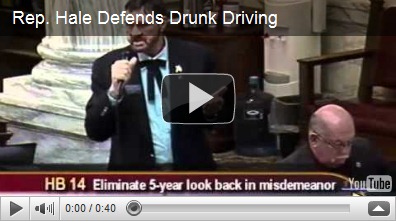
Rep. Alan Hale, R-Basin, was one of the 12 no votes on the measure. Hale, who according to his campaign website owns the Saddle Bar and CafĂ© in Basin, gave a passionate speech in opposition to not only HB14, but to all of the bills aimed at stiffening DUI laws. According to Hale, the DUI bills are “destroying” small businesses by preventing people from drinking and driving.

The AP story has a rather truncated quote from Hale’s opposition, so here’s the full text of Hale’s floor speech:

"These DUI laws are not doing our small businesses in our state any good at all. They are destroying them. They are destroying a way of life that has been in Montana for years and years. These taverns and bars in these smaller communities connect people together. They are the center of the communities. I'll guarantee you there's only two ways to get there: either you hitchhike, or you drive, and I promise you they're not going to hitchhike."

Here’s the video if you watch to watch it yourself. It was posted by user Montana Democrats.

Friday, March 25, 2011

All but seven state lawmakers get health benefits

Caduceus_on_whiteThe Legislature finally agreed to Lee Newspapers’ request to release all the names of state lawmakers covered by taxpayer funded health care benefits.

Mike Dennison has the story here.

The Legislature’s former chief legal counselor, Rob Stutz, initially denied Dennison’s request in January.

Lee Newspapers indicated that it planned to sue, but held off after Sen. Anders Blewett, D-Great Falls, and Sen. Kendall Van Dyk, D-Billings, introduced a bill  that would require the Legislature to disclose the information.

Senate Bill 284 passed the Senate 47-3, but was tabled Wednesday without debate in the House Human Services committee.

Rep. Ellie Hill, D-Missoula, attempted to blast the motion on the House floor today. GOP opponents argued that the measure was aimed at “embarrassing Republicans” for criticizing federal health care reforms while at the same time accepting taxpayer-funded health benefits. The motion failed 38-54.

Nevertheless, the Legislature today released the names of lawmakers accepting benefits.

Here’s the list.

Here’s the letter Legislative Services Division Executive Director Susan Fox wrote to Dennison.

Will the Legislature adjourn early?

Republican lawmakers — ever mindful of Gov. Brian Schweitzer's veto power—are considering a plan to temporarily adjourn the legislative session after delivering the state budget bill to the governor's desk in an attempt to avoid a special session.

Last week, Senate President Jim Peterson, R-Buffalo, and House Speaker Mike Milburn, R-Cascade, requested a memo from the Legislature's legal staff examining possible veto scenarios. The memo outlines the procedural requirements with respect to House Bill 2, the spending bill, including the Legislature's legal and procedural options should the governor veto the budget while the Legislature is in session.

Here’s a link to the full memo from acting chief legislative council Todd Everts.

MilburnMilburn confirmed Wednesday that GOP lawmakers are considering the idea of putting HB2 on Schweitzer's desk early, and then taking a break from the session and resuming it after Schweitzer makes his move on the budget.

"We have certainly studied that option," Milburn said.

Schweitzer sent a clear message to the GOP-controlled Legislature last month when he unveiled a "veto" branding iron.

Schweitzer refuses to say which bills he plans to veto, but he has indicated that he wouldn't hesitate to use the "hot iron" on HB2 if the measure is not to his liking.

schweitzer vetoThe governor repeatedly has criticized GOP-proposed cuts to human services and education, including a plan to turn down $120 million in federal money.

"We've mentioned to them that they're just going to make taxes go up for property owners, and make health care costs go up for people who are paying private health insurance. Those really aren't acceptable solutions," Schweitzer said in an interview Wednesday.

Once a bill gets to his desk, the governor has 10 days to decide whether to sign it into law, administer a line-item veto, use an amendatory veto or veto the bill in its entirety. If Schweitzer doesn't sign or veto the bill, it becomes law after 10 days.

If the governor vetoes a bill that arrives on his desk after the Legislature has adjourned for the session, lawmakers can attempt to override the veto by mail-in ballot. If they fail to override the veto, the bill dies.

However, the state Constitution requires that lawmakers pass a budget, so if Schweitzer vetoes HB2 after lawmakers go home for the summer and they are unable to muster enough mail-in votes to override it, the Legislature must return to the Capitol for a special session at a date of the governor's choosing.

That's the scenario GOP leaders want to avoid.

If they get the budget on the governor's desk with legislative days to spare, and then temporarily adjourn for the 10 days Schweitzer has to act on the bill, it will leave time for lawmakers to take up the measure without a special session.

"The idea of adjourning early to leave time was to eliminate the possibility of a special session," Milburn said. "I would say that was more of an option earlier on. A lot of this depends upon what the governor wants to do. Is he interested in using his veto brand on House Bill 2 and then get on with the issues, or sit down and discuss it early on?"

Milburn said he and Peterson briefly met with Schweitzer about the budget on Monday.

"I think that after speaking to him and with Senator Peterson and I, we're all willing to sit down early in the process and get the executive branch included in House Bill 2," Milburn said.

Senate Majority Leader Jeff Essman, R-Billings, was less candid about the GOP's strategy for heading off a budget veto.

Asked if Senate Republicans were exploring the possibility of adjourning early, Essman said, "We are trying to pass a responsible budget that tightens the belt of state government, just like people are trying to do in their own homes. We think we need to go through a fact-based budgeting process. We think every dollar in the state budget needs to be looked at."

When pressed, Essman refused to say whether Republicans are considering early adjournment.

"We think it's important to have a process that we put forth a balanced budget that's responsible for all of Montanans, and give the governor an opportunity to look at it and react to it," Essman said. "I would say the requested memo speaks for itself in terms of all options being examined."

Democratic lawmakers said they are distressed with the pace at which Republicans are pushing the budget and related spending bills through the legislative process.

"I think they're pushing these bills without having given thoughtful consideration," Senate Minority Leader Carol Williams, D-Missoula, said. "The speed with which they're trying to get done is undercutting the quality of the product that we're putting out here. That does disturb me."

The Senate is expected to take up the budget early next week, and pass it as early as Wednesday or Thursday. If the House then accepts the Senate's changes to HB2, the measure could arrive on the governor's desk by the end of the week.

"I would say that would be iffy," Milburn said. "The House may not accept the amendments the Senate puts on."