Showing posts with label environment. Show all posts

Thursday, October 10, 2013

When do violent gun threats become acts of terrorism? Perhaps never in Montana…

In Sept. 2009 comedian Joe Lipari returned to his New York apartment after spending several hours at a nearby Apple Store. Lipari went to the store to get his malfunctioning iPhone fixed, but when the concierges ignored him for hours, the frustrated Lipari returned home and flipped on the tube.

As Lipari tells the story the movie “Fight Club” was on. There’s a scene in the film where Edward Norton’s character leaves a copy of the Fight Club rules (you know: The first rule of Fight Club is you don’t talk about Fight Club) on the copy machine.  

In the scene Norton warns his boss to be careful who he talks to about the document he found on the machine or….

“…the button-down, Oxford-cloth psycho might just snap, and then stalk from office to office with an Armalite AR-10 carbine gas-powered semi-automatic weapon, pumping round after round into colleagues and co-workers…”

Lipari, stoned and amused with himself, paraphrased the quote on Facebook but inserted something about the Apple Store concierges in the post.

Soon thereafter he answered a knock at his door and was greeted by fully armed members of the New York City S.W.A.T. team with their MP5 machine guns drawn.

Lipari was charged with making terrorist threats and spent the better part of the next two years in court trying to clear his name.

So what does this anecdote have to do with Montana? 

I bring it up because it makes me wonder what’s going to happen to Steve Connly, the Montana man who not only sent “hate mail” (his words) to the Helena-based Alliance for the Wild Rockies in which he specifically threatened gun violence, but who also has a habit of threatening the President of the United States on his Facebook page:

(WARNING - EXPLICIT RACIST LANGUAGE)

Connly fb threat 1image

“Should be anti obama armory.. Barack Obama Thats right pretty nigger, millions more where these came from, just you wait.. your day will come.. and an fyi, I do not call you nigger simply because you are black.. It is because you fit the TRUE definition of a NIGGER.. Which SLAVES used to call the MASTERS before they were freed. Thats right you are a true NIGGER.”

And then there’s this gem:

Connly fb threat 2

“An fyi, I am probably going to be kicked off facebook again very soon. Been trolling obama's page and saying many things which should get him ticked off. Serves him right. I say execute that bastard AT the WWII memorial that he has thrown such a big fit about keeping us away from. FEDERAL LAND IS OUR LAND NOT YOURS YOU GREEDY BASTARD and you cannot keep us out of it. WE pay your overly extravagant paycheck, now WE need to hold you accountable for your actions AGAINST the constitution and AGAINST the american people. DO NOT BE FOOLED SHEEPLE, if he is not impeached this year we will have civil war. His actions prove this point. When he doesn't get his way, he throws a fit and takes it out on american people. WE WILL PUSH BACK mark my words little man, your day will come.”

How do I know the Steve Connly who made these Facebook threats against the President is the same guy who wrote to the Alliance for the Wild Rockies and said he would “love the chance” to use guns on them?

Because he admitted it on the Montana Logging Facebook page:

image

image

After the Tribune published the story of Connly’s threat, a few like-minded souls took to the Trib’s comment section to pile on the treats:

image

Mike Prester, of Belgrade, thinks a “shooting would be to [sic] good!!!!”

image

So all of this has got me wondering…. if a New York City comedian can be charged with making terrorist threats and spend the better part of two years in court for posting a paraphrased movie quote on his Facebook page, what happens to Montanans who not only make specific threats of violence against individuals, but also generalized violent threats against the President of the United States?

It’s not hard to imagine that those on the receiving end of threats of deadly force –- or their families -- are terrified. Or at least that is the intention of the threat, isn’t it?

image

FBI spokeswoman Patricia Speelman declined via email to comment on the status of the case other than to say:

“The FBI takes threats very seriously and investigates them thoroughly with the assistance of our federal, state, and local law enforcement partners.”

For those who might be tempted to dismiss these threatening comments as “just talk,” consider the following:

According to environmental investigative group Global Witness, more than 700 environmental activists, journalists and community members were murdered worldwide between 2002-2011.

In Montana environmentalists and conservation advocates know too-well the threat of violence.

As former Missoula Independent reporter Carlotta Grandstaff reported in 2001, they’ve had their homes shot-at, burned down and vandalized:

“In the Bitterroot, at least one environmentalist has received death threats for his opposition to timber sales. Someone fired shots at another activist’s house, leaving bullet holes in a fence. The home of yet another activist was burned to the ground in a mysterious fire. Still another activist was thrown off his job when his employer learned of his involvement with environmental politics. At a public meeting on a grizzly reintroduction plan in Salmon, Idaho, one pro-grizzly speaker was booed and jeered while someone from the audience yelled, ‘get a rope.’ Then, of course, there’s the suspicious death earlier this year of Flathead Valley activist Tary Mocabee.”

In 2001 Flathead Valley activist and Tary Mocabee mysteriously drowned in a shallow creek near her home. Mocabee’s friends told producers for the PBS documentary “The Fire Next Time” that some in the environmental community suspected foul play based on Mocabee’s environmental and social activism.

And lets not forget the not-too-distant past when a group of anti-government extremists from Connly’s neck of the woods plotted to murder a long list of public officials from cops to judges to dog catchers. The Project 7 day of reckoning was supposed to commence on Earth Day.

The alleged “mastermind” of Project 7 plot, David Burgert, is still missing after disappearing into the woods near the Montana-Idaho border after a shootout with police.

There’s plenty room for civil debate and disagreement about forest and wildlife management, health care, foreign and domestic policy, etc. But when the debate degrades to threats of physical violence, we have lost our way.

In America, and in Montana, civilized citizens settle their differences within the confines of the rules we agreed to through our representative democracy.

When someone steps outside those rules, when they resort to threats of violence in order to intimidate and violate the rights of those they disagree with, they should be met with those agreed upon rules and in short order.

Tuesday, August 23, 2011

Livingston actress/activist Margot Kidder arrested at the White House

image

Actress and activist Margot Kidder, of Livingston, was reportedly arrested on the steps of the White House today. Kidder, dressed in black in the photo above, was in Washington as part of a two-week protest to push the Obama Administration to deny Canadian oil giant TransCanada’s permit to build the Keystone XL pipeline. Kidder is active in the group Montana Women For. She was photographed holding a sign that said “Montana Women For An Oil Free Future.” 

kidder arrested

Kidder, best known for her role as Lois Lane in the Superman movies, was arrested fellow actress Tantoo Cardinal (in orange), who starred in Legends of the Fall and Dances with Wolves.

According to the Canadian Press:

Canadian actress Margot Kidder was among the latest slate of environmentalists to be arrested outside the White House on Tuesday, handcuffed and sent to jail on the fourth day of a two-week civil disobedience campaign against TransCanada's Keystone XL pipeline.

Kidder, born in Yellowknife but now living in Montana as an American citizen, was arrested alongside fellow Canadian actress Tantoo Cardinal by U.S. Park Police for refusing to vacate a White House sidewalk.

Just as dozens of others have since Saturday, Kidder and Cardinal were charged with failing to obey an order governing protests on the sidewalk, police said. They were expected to be released later Tuesday.

"We're the first state the pipeline goes through," Kidder, 62, best known for playing Lois Lane in four "Superman" movies, said before her arrest.

She marched from Lafayette Square, directly north of the White House, to the sidewalk lining the northern edge of the presidential residence along with three other women who described themselves as "Montana grandmothers."

"It's bound to leak, there's no way it's not going to ... they always assure us these things are safe, and they never are safe," Kidder said.

Wednesday, July 20, 2011

Billionaire candy bar mogul buys one-third of Tongue River Railroad, gets into coal business

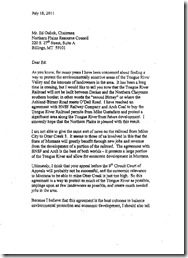
Mars letter1

Billionaire Forrest E. Mars, Jr. has reached an agreement with BNSF Railway Co. and coal giant Arch Coal to buy one-third of the Tongue River Railroad. The candy bar and pet food mogul said the purchase would prevent the construction of the proposed railway along major stretch of the Tongue River Valley in southeastern Montana.

In a July 18 letter to Ed Gulick, chairman of the conservation group Northern Plains Resource Council, Mars said he would no longer help fund ongoing legal challenges or future litigation related to the controversial 130-mile long railroad that would transport coal from Montana to Midwestern power plants and beyond.

"I have reached an agreement with BNSF Railway Company and Arch Coal to buy the Tongue River Railroad permits from (Tongue River Railroad president) Mike Gustafson and protect a significant area along the Tongue River from future development," Mars wrote. "I sincerely hope that the Northern Plains (Resource Council) is pleased with this result."

[Click here to see the letter]

Mars concluded the letter by saying, "I should also tell you that I will not be helping you fund the current appeal or any future litigation on these issues."

According to Mark Fix,  past chair of Northern Plains Resource Council and a rancher along the route of the proposed railroad, Mars supported Northern Plains in the past when the Tongue River Railroad threatened to cross Mars' 82,000-acre Diamond Cross Ranch.

In July 2010 Northern Plains and Fix petitioned the Surface Transportation Board, the federal agency that regulates railroad mergers, to stop construction of the Tongue River Railroad arguing that no adequate study of the environmental impacts of the coal train had been completed. The STB denied the petition and the case is currently before the 9th Circuit U.S. Court of Appeals.

Fix said Mars' recent actions will have no affect on the ongoing litigation.

"We've got lots of members and basically we're a grassroots organization," Fix said. "We rely on our members. We don't look to huge donors to fund our campaigns."

Calls to Mars' attorney and managers at the Diamond Cross Ranch were not returned as of press time.

Mars said in his letter that under the deal the Tongue River Railroad would not be built between Decker, near the Wyoming border, and the southern border of the Northern Cheyenne Indian Reservation near O'Dell Creek road, about six miles northeast of Birney. The portion of the proposed railroad between O'Dell road, approximately 10 miles south of Ashland, and Miles City, would not be affected by the deal, according to Mars.

Conservation groups opposed to the railroad and the development of massive coal mines in the Otter Creek reacted harshly to the news Wednesday.

Ranchers and farmers along the route have fought for decades to prevent its construction, arguing that it would bisect farms and ranches in the Tongue River Valley and reduce property values, separating grazing land from water, spread weeds and possibly start fires.

“We have always been dedicated to protecting the entire Tongue River Valley,” said Jeanie Alderson, vice chair of Northern Plains a third-generation Tongue River rancher. “I depend on my neighbors as much as they depend on me. Our operations work because we are not dissected by an industrial railroad.”

Jim Jensen is the executive director of the Montana Environmental Information Center. That group sued the state Land Board in May 2010 arguing that board failed to weigh the environmental and economic consequences or consider any alternatives that might be more beneficial to the state when it agreed to lease 500 million tons of Otter Creek coal to Arch Coal for $86 million. That case is still pending in district court.

"This letter means that Forrest Mars won't have a railroad crossing his property and several other ranchers will be saved from that fate, but the Tongue River Railroad between Miles City and Ashland also crosses a lot of property and the river is beautiful there too," Jensen said. "We will do everything in our power forever to stop the mining of Otter Creek because coal is the fuel of the past. It's dirty and it's changing our climate."

Opponents of the project have speculated that one of the driving forces behind the Tongue River Railroad was the desire to ship Wyoming to Midwest power markets. Now landowners say the focus has shifted and the purpose is to transport Otter Creek coal to ports on the West Coast and on to markets in China.

"We will not allow the Tongue River Railroad to be built because it will tear apart Montana ranch land and negatively impact agriculture in southeastern Montana to haul more of our coal to China just to make corporations and rich individuals richer," Fix said.

Mars said the state would "greatly benefit" from new jobs and revenue created by the developing of the Ashland to Miles City-stretch of the railroad.

"The agreement with BNSF and Arch is the best of both worlds — it projects a large portion of the Tongue River and allow for economic development in Montana," Mars wrote.

Critics disagree.

"I disagree completely with Mr. Mars' contention that that will somehow be good for Montana," Jensen said. "It won't be good for Montana, won't be good for the region and certainly won't be good for the word. We do not need more death trains hauling coal to be burned."

Monday, July 11, 2011

Schweitzer still supports oil sands/Keystone XL despite tough talk on Yellowstone oil spill

image

Gov. Brian Schweitzer has taken a tough public stance against ExxonMobil in the days following the 44,000 gallon Yellowstone River oil spill. Schweitzer has said he’ll be on Exxon “like smell on skunk” and that the Yellowstone River won't be clean, "until Montana says it’s clean.” Schweitzer has publically accused Exxon officials of not being transparent, directing security guards to keep the press away from the unified command center, and not being honest about the true nature of the spill. He's said that the company's interests "are not aligned with Montana's interest," and that ExxonMobil officials' "primary goal here was to limit the liability to the shareholders, not to be straightforward with the details of the spill and subsequent cleanup."

One Politico headline initially proclaimed that “Montana gov has boot on neck of ExxonMobil,” though the headline was recently changed to somewhat less hyperbolic “Montana gov on ExxonMobil like 'smell on a skunk.’

Many environmental groups – including representatives from the National Wildlife Federation on a conference call to reporters last week — have lauded Schweitzer for his hard-line approach to dealing with ExxonMobil during the disaster.

But others have accused Schweitzer of talking out of both sides of his mouth on the issue. They cite Schweitzer's  ardent support for coal, oil and gas development in Montana, his backing of ExxonMobil’s plan to truck more than 200 massive Korean-built tar sands processing modules across the state into Canada, and his support for Keystone XL pipeline, which would pipe Canadian tar sands crude (the same type of crude that fouled the Kalamazoo River when an Enbridge Energy pipeline burst there last year) from the Montana-Canada border to refineries along the Texas Gulf Coast.

Schweitzer on Wednesday told NPR On Point host Tom Ashbrook there is no contradiction between his support for fossil fuel development and his hard-lined response to ExxonMobil’s cleanup of the Yellowstone:

“We’re going to continue to develop energy in Montana. We’re an energy state. But we will not be a sacrifice zone for this energy’s needs. We will develop this energy on our terms, we will protect the landscape and the wildlife of Montana for this generation and future generations, and that energy that we develop in Montana will be developed on our terms.”

The Montana Environmental Information Center’s Jim Jensen doesn’t buy the notion that fossil fuel energy development can be “done right,” as Schweitzer and others claim.

“They’ve never done it right yet,” Jensen said on the same hour-long radio program.

As for Schweitzer, Jensen had this to say:

“Just two weeks ago he had a well-publicized meeting here in Helena with ExxonMobil executives and the result of that was him telling us that we should trust them to haul these massive loads of equipment up the Snake River, up the Lochsa River in Idaho and then the Blackfoot River in Montana into Alberta where they are developing these massive, hideous tar sands…he is a short-skirt cheerleader for that project.”

Missoula Independent columnist and former longtime environmental lobbyist George Ochenski also criticized Schweitzer for his continued support of the megaloads and Canadian tar sands development:

“Schweitzer has been a big booster of allowing Exxon to ship mega-loads of oil production equipment to Alberta's tar sands on Montana's two-lane highways. He also cheers on the proposed Keystone XL pipeline, which would be two and a half times larger than Exxon's ruptured line and transport tar sands crude across Montana. We can only hope when he finally gets a first-hand look at the destruction such corporate failures engender, he might reconsider his far-too-cozy relationship with Big Oil. His allegiance should be to Montanans, not Exxon Mobil.”

I recently asked Schweitzer if his lack of trust in ExxonMobil and their lack of transparency in dealing with the Yellowstone River oil spill has colored his views on the Keystone XL pipeline or Exxon’s impending megaload transportation project.

Here’s what he had to say:

“Well, as I've said from the very beginning, we would trust but verify. But at least as for the pipeline division I'm down to verifying and then verifying again.

“Any study that has been conducted on megaloads has been conducted within the context of the Montana Environmental Policy Act, and (the company) and the Montana Department of Transportation are following the Montana Environmental Policy Act to the letter of the law, as the public expects us to do.”

Wednesday, August 11, 2010

Protests spew over Montana-Gulf pipeline plan

As I wrote about in USA Today, Environmental groups and landowners, upset by last month's oil spill in Michigan, are urging the Obama administration to deny a proposal for an oil pipeline that would go from the Montana-Canada border to refineries along the Texas Gulf Coast.

Alberta-based TransCanada's proposed 1,661-mile Keystone XL pipeline would link up with its existing 2,151-mile Keystone pipeline, which began operations in June, and go through Montana, South Dakota, Nebraska, Kansas, Oklahoma and Texas.

The Keystone XL would cross dozens of rivers and streams from Montana to Texas, including the Missouri and Yellowstone Rivers, and the the Ogallala Aquifer, a vast shallow underground water table that's a major source of water for much of the High Plains region.

Opponents say last month's spill underscored the dangers of the United States' reliance on fossil fuels. A pipeline ruptured on July 25 and spilled nearly a million gallons of crude oil into a tributary of the Kalamazoo River in southwestern Michigan, according to Environmental Protection Agency estimates.

Environmental groups such as the Sierra Club, Friends of the Earth and the Natural Resources Defense Council opposed the Keystone XL project even before the Michigan spill, but the incident has increased scrutiny and elevated concerns.

Last week representatives from some of the nation's leading environmental groups wrote a letter to Transportation Secretary Ray LaHood urging him refuse to issue a permit to TransCanada:

"Last week’s Enbridge oil pipeline spill of more than 1 million gallons into the Kalamazoo River in Michigan is the latest of more than 2,500 significant pipeline incidents that have occurred in United States over the last decade, which have resulted in 161 fatalities and 576 injuries. Enbridge’s operations alone were responsible for over 600 spills that released more than 5 million gallons of oil into the environment. This history of pipeline spills taken alongside the BP Gulf oil spill catastrophe, clearly demonstrate the need for additional government oversight and safety measures when it comes to our oil extraction and transportation."

***

"Recognizing DOT’s role as a consulting agency on TransCanada’s presidential permit application to the State Department for the Keystone XL Pipeline Project – the next major tar sands oil pipeline under consideration – we urge DOT to recommend that the pipeline not be built."

Groups opposing the expanded pipeline have also popped up on Facebook. Last week, protesters demonstrated outside Chicago's Palmer House Hilton hotel, where President Obama was attending a Democratic fundraiser, and hung a banner over Obama's Lake Shore Drive route that read, "Pres. Obama: Stop the Keystone Pipeline, Stop the Tar Sands."

"This disastrous oil spill in Michigan is yet another wake-up call to the tragic impacts of our oil dependence," says Alex Moore of the environmental group Friends of the Earth. “Coming on the heels of the Deepwater Horizon disaster in the Gulf of Mexico, this spill reinforces the need for us to build a clean energy economy, not more pipelines.”

TransCanada's vice president of Keystone Pipelines, Robert Jones, says the company is committed to safety and will use state-of-the-art leak-detection systems with automatic shut-off valves. Emergency response plans, he says, are already in place if a leak were to occur.

"We could react to that leak automatically," Jones says.

Before TransCanada can begin construction, it must get approval from several federal agencies, including the State Department, the Army Corps of Engineers and the Bureau of Land Management.

Last month, the State Department added 90 days to the review process.

TransCanada also needs permits from Montana and South Dakota.

Utility officials in Nebraska, Kansas, Oklahoma and Texas say their states don't require permits for interstate oil pipelines. The South Dakota Public Utilities Commission approved the project in March. Tom Ring of the Montana Department of Environmental Quality says a decision could come this fall.

TransCanada hopes to begin construction early next year and complete the project by early 2013, spokesman Terry Cunha says.

Once completed, the combined Keystone system would have the capacity to deliver 1.1 million barrels of crude oil per day to U.S. refineries, including 500,000 barrels from the new portion, which is expected to cost $7 billion, Cunha says.

The proposed pipeline would run through part of Agnes Reeves' ranch in eastern Montana. Her son, Tom Reeves, says the pipeline spill in Michigan has exacerbated his family's concerns.

“The Michigan spill shows that pipeline spills can and do happen,” Reeves said. “That it was a terrible environmental disaster, and I certainly would not want such a disaster to occur in Montana.”

Last week TransCanada withdrew its application for a special permit that would have allowed the company to pump oil through the pipeline at higher-than-normal pressures. Critics had blasted the waiver application as a profit-boosting measure that would have increased the risk of a catastrophic pipeline failure.

TransCanada officials dismissed that accusation, saying the waiver request was based pipeline standards used in Canada.

Jones, said if U.S. demand for Canadian crude oil requires the company to expand its pipeline system in the future, then the company would consider re-applying for a safety waiver in the future.

“I think it would be speculation for us right now to determine when that would happen,” Jones said.

Tuesday, June 9, 2009

"Leaner. Greener. Faster. Smarter."

"This is not about going out of business, this is about getting down to business."

That's from a recent TV ad for YOUR new General Motors. I say yours, because you and I are now the majority shareholders in GM. Here's the full ad:


This is kinda refreshing coming from the company that brought us the Hummer.

Sorry, I can't resist:

The Colbert ReportMon - Thurs 11:30pm / 10:30c
Difference Makers - The National Hummer Club
colbertnation.com
Colbert Report Full EpisodesPolitical HumorStephen Colbert in Iraq

Don't get me wrong, I hope GM--and the rest of the nation's automakers--have finally turned a corner, but why did it take a total financial collapse and a massive government buyout before GM decided it was time to innovate beyond "bigger, badder and bolder" to "leaner, greener, smarter?"

Perhaps if they'd gone down that road a decade ago they, and we, wouldn't be in this mess. Better late then never I suppose.